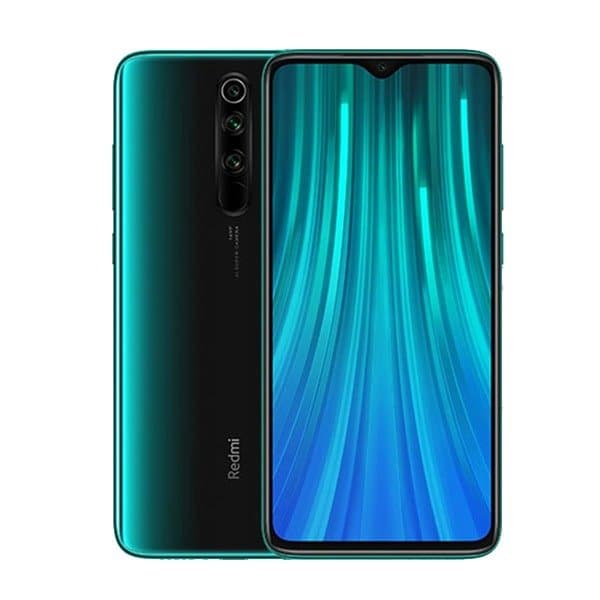
Xiaomi Redmi K60 Pro vs Xiaomi Redmi Note 8 Pro
Comparing 2 products
| General Overview | ||
| Device Type | Bar | Bar |
| Model | Redmi K60 Pro | Mi Note 8 Pro |
| Announced | 2023, January | 2019, August |
| Released | 2023, January | 2019, September |
| Status | Available | Coming Soon |
| Design | ||
| Type | Bar | Bar |
| Dimensions | 162.8 x 75.4 x 8.6 mm or 8.9 mm | 161.3 x 76.4 x 8.8 mm (6.35 x 3.01 x 0.35 in) |
| Weight | 201 g or 205 g (7.09 oz) | 199 g (7.02 oz) |
| Colors | Black, White, Mint, Champion Black | Black, Red, Blue, White |
| Protection | - | Front/back glass (Gorilla Glass 5) |
| Network | ||
| 2G Network | Yes | GSM 850 / 900 / 1800 / 1900 - SIM 1 & SIM 2 |
| 3G Network | Yes | HSDPA 850 / 900 / 1900 / 2100 |
| 4G Network | Yes | LTE band 1(2100), 3(1800), 5(850), 7(2600), 8(900), 40(2300), 41(2500) |
| 5G Network | Yes | - |
| SIM | Nano SIM | Nano SIM |
| Dual SIM | Yes, Dual SIM (Nano-SIM, dual stand-by) | Yes, Hybrid Dual SIM (Nano-SIM, dual stand-by) |
| Display | ||
| Display Type | OLED | IPS LCD |
| Size | 6.67 inches, 107.4 cm2 (~87.5% screen-to-body ratio) | 6.53 inches, 104.7 cm2 (~84.9% screen-to-body ratio) |
| Resolution | 1440 x 3200 pixels | 1080 x 2340 pixels |
| Display Colors | 68B colors | 16M colors |
| Pixel Density | 226 ppi density | 395 ppi density |
| Touch Screen | Yes | Capacitive Touchscreen |
| Features | 120Hz, Dolby Vision, HDR10+, 1400 nits (peak) | - |
| Display Protection | - | Corning Gorilla Glass 5 |
| Media | ||
| FM Radio | Unspecified | Yes |
| Earphone Jack | No | Yes |
| Camera | ||
| Camera Set | Triple Cameras | Quad Cameras |
| Main Camera | 54 MP, f/1.9, (wide), 1/1.49", 1.0µm, PDAF, OIS | 64 MP, f/1.8, (wide), 1/1.7", 0.8µm, PDAF |
| 2nd Camera | 8 MP, 118˚ (ultrawide), 1/4", 1.12µm | 8 MP, f/2.2, 13mm (ultrawide), 1/4", 1.12µm |
| 3rd Camera | 2 MP, f/2.4, (macro) | 2 MP, f/2.4, 1/5", 1.75µm (dedicated macro camera) |
| Camera Video | 8K@24fps, 4K@30/60fps, 1080p@30/60/120/240/960fps, 720p@1920fps, gyro-EIS | 2160p@30fps, 1080p@30/60/120fps, (gyro-EIS) |
| Features | HDR, panorama | HDR, panorama |
| Flash | Dual-LED dual-tone flash | Dual-LED flash |
| Selfie Set | Single Camera | Single Camera |
| Selfie Camera | 16 MP, (wide), 1/3.06", 1.0µm | 20 MP |
| Selfie Video | 1080p@30/60/120fps | 1080p@30fps |
| Features | HDR | HDR |
| 4th Camera | - | 2 MP, f/2.4, 1/5", 1.75µm, depth sensor |
| Software | ||
| OS | Android 13 | Android 9.0 (Pie) |
| User Interface | MIUI 14 | MIUI 10 |
| Hardware | ||
| Chipset | Qualcomm SM8550 Snapdragon 8 Gen 2 (4 nm) | Mediatek Helio G90T (12nm) |
| CPU | Octa-core (1x3.2 GHz Cortex-X3 & 2x2.8 GHz Cortex-A715 & 2x2.8 GHz Cortex-A710 & 3x2.0 GHz Cortex-A510) | Octa-core (2x Cortex-A76 & 6x Cortex-A55) |
| GPU | Adreno 740 | Mali-G76 MP4 |
| RAM | 8/12/16 GB | 8 GB |
| Internal Storage | 128/256/512 GB | 64/128 GB |
| Card Slot | No | Yes, microSD, up to 256 GB (uses shared SIM slot) |
| Sensors | Fingerprint (under display, optical), accelerometer, gyro, proximity, compass, color spectrum | Fingerprint (rear-mounted), accelerometer, gyro, proximity, compass |
| Connectivity | ||
| Bluetooth | 5.3, A2DP, LE | 5.0, A2DP, LE |
| Wi-fi | Wi-Fi 802.11 a/b/g/n/ac/6e, dual-band, Wi-Fi Direct | Wi-Fi 802.11 a/b/g/n/ac, dual-band, Wi-Fi Direct |
| Wi-fi Hotspot | Yes | Yes |
| USB | USB Type-C 2.0, OTG | 2.0, Type-C 1.0 reversible connector |
| GPS | Yes, with A-GPS (L1+L5), GLONASS (G1), BDS (B1I+B2a+Bc), GALILEO (E1+E5a), QZSS (L1+L5), NavIC | Yes, with A-GPS, GLONASS, BDS |
| NFC | Yes | Yes |
| Wireless Charging | Yes, 30W | - |
| Data | ||
| GPRS | Yes | Yes |
| EDGE | Yes | Yes |
| Speed | HSPA, LTE-A (CA), 5G | HSPA 42.2/5.76 Mbps, LTE-A |
| Battery | ||
| Battery Type | Li-Poly (Lithium Polymer) | Li-Poly (Lithium Polymer) |
| Capacity | 5000 mAh, Battery | 4500 mAh battery |
| Placement | Non-removable | Non-removable |
| Fast Charging | Yes, 120W, PD3.0, QC3+, 100% in 19 min (advertised) | Yes, 18W (Quick Charge 4+) |
| Standby | - | - |
| Talk Time | - | - |
| Music Play | - | - |